
There has been some healthy debate on twitter/XelonXX about models of teaching, specifically the I do/We do/You do model (here is a good blog explaining the model for those unfamiliar). These kinds of discussions are always hard to have within the confines of tweets, so here I want to set out a few things:
- Why common generalisable models for teaching are so important
- Why they often are at risk of lethal mutations?
- My personal model for teaching
- Why are models so important?
The biggest barrier to improving teaching is not governments, money or Ofsted. It’s complexity. Teaching is incredibly complex and nuanced. Like a good teacher, a teacher trainer needs to find a way to simplify and codify common aspects of teaching so that novices in the field can be supported on their journey to expertise. The complexity also makes it very hard to create feedback loops, which are vital to developing teaching practice. Models that create a shared language can really help this by making feedback conversations much more precise and efficient.
Consider these two examples for how a shared language can help:
“I really liked how you used the miniwhiteboards to ask questions that all students had to think about and answer. this will likely lead to more learning over time as more students will be thinking harder in each lesson. It also gave you data that you checked and provided feedback on so that students with misunderstanding could receive feedback and demonstrate they now know the correct answer by the end of the task.”
“Using show me with miniwhiteboards kept the participation and think ratio high and you did a great job narrating the errors you found and rechecking.”
I go into more detail on this point here in a old blog.
These models will always need to be highly generalisable as subjects always have different needs but they should aim to identify the key areas of lessons so the debate within and between departments is not ‘what is in a good lesson’ but ‘what do these things look like in X when done well?’ It allows staff to share ideas because it implies that what works in English might be of value to other subjects.
2. Why are models often at risk of lethal mutation?
I’ve written previously how I think the mechanism for lethal mutations occurs.
Models run the risk because the opportunity cost for developing a good understanding of the model is often seen as not time well spent. People get a surface understanding and think they no enough and stop there. So models by their simplicity and generalisability are prone to this problem. It need to be made clear though that this is an implementation problem more often than a problem with the model itself. No model is perfect and some are better than others, but most can be helpful if implemented effectively. In Middle Leadership Mastery I draw on Matthew Benyohais work on principles vs practices. I think a key tool to avoiding lethal mutations is to surround our descriptions of good practice with a clear understanding of the principles we have used to recommend them. This will help teachers avoid examples which do not adhere to these principles and hopefully avoid publicising mutated versions.
3. My model of teaching
Below is a model I use for teaching. I didn’t invent it, it’s heavily influenced by many other great teachers. Although I did make this diagram which is think is quite nifty. I’ll give a quick summary of each stage below. Its worth noting that is does not necessarily demonstrate what should happen in ‘a lesson’ as but more the principles that lessons should contain.
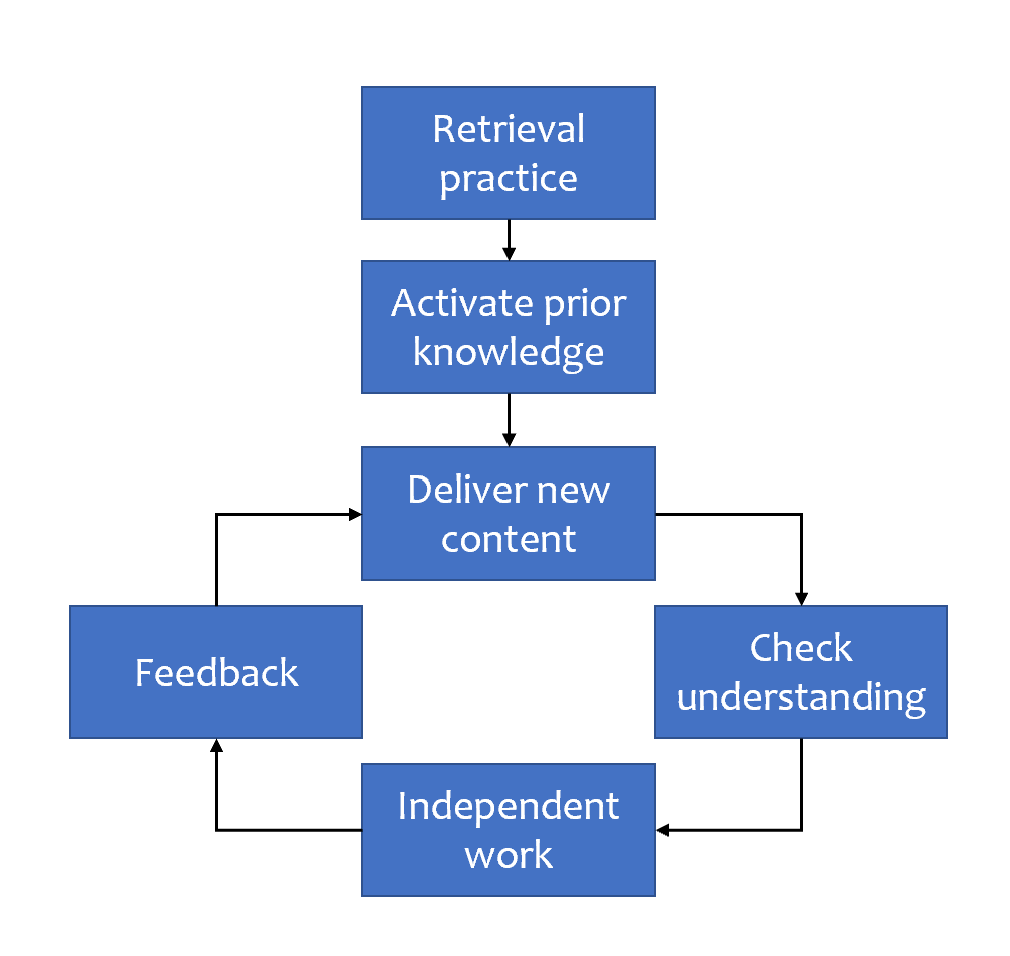
- Retrieval practice: Yes RP can be done many ways but I have found the best place for planned retrieval practice is as a separate section at the start of a lesson. Because of that it sits at the start. I’ve written about how I do this and the reasons before here.
- Activating prior knowledge. Before any new content is delivered we know that it helps to activate prior knowledge so students can integrate the new information into their existing knowledge. It also allows us to identify any gaps and act on them. A broad range of approaches could be used from simple quizzing, reflections on real world scenarios the students have experienced and context-based predictions to name three. Good blog on the concept here by Claudia Allan.
- Deliver new content. This is where the magic happens. The teacher uses their best judgement to craft and explanation and provide guidance and faded examples to deliver new content or concepts. This could be any length of time and use a variety of methods, but should include examples and non-examples. In the I/We/You model this would be the whole of the I and the We that is guidance fading. The best source for how to craft the perfect explanation is here best stuff on faded examples is here
- Checking understanding. Simply teachers need to design tasks that can check all students have grasped the key components, concepts and relationships that the teacher set out to explain. Any method chosen here needs to have really high levels of participation and allow teachers to gather data quickly. I pretty much always use miniwhiteboards, but here is another option; ‘heads down‘ by Pritesh Riachura.
- Independent work. Students need to think about what they have learnt to encourage it to be retained and explore some of the validity conditions. You could do group work, practical work here. The key thing is there is much less teacher support so they have to struggle a little. Desirable difficulties etc…
- Feedback. Again this should be fairly controversial. Students need feedback so they can improve. This might be going through answers, show calling a good example and giving students a chance to relfect.
The stages 3-6 are in a cycle to show you might cover them all in 10 mins or it might take 100 its context dependent.
This is my current model I use when training teachers, departments, schools and MATs. If you want to explore how I could help you develop you staff then get in touch by clicking the CPD tab at the top of the page.
 Adam Robbins Education
Leave a comment