

Teaching is a very demanding and intensive profession. Days are full of things to do and often the ambition of what a school wants to achieve in a given week, month or year is well beyond the time available to do so.
Teachers and leaders will often go on courses or have training on how to prioritise their work to ensure the most important things get done first. Middle leaders will get shown a simple rubric to help them make decisions. It will look something like this. I think it’s often known as the Eisenhower matrix.
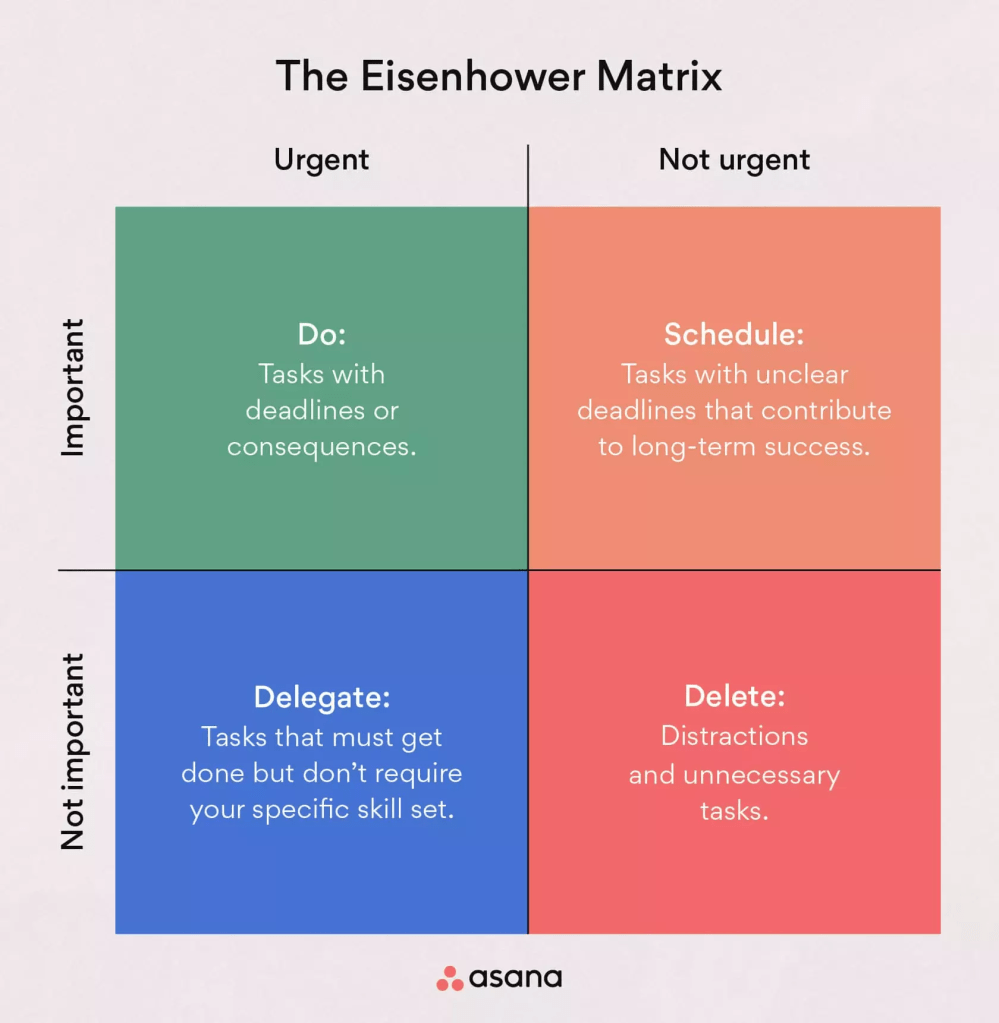
We all know that the top two are the most important, heck it’s in their name!
We can see from this version that the non-urgent important things need to be planned so they don’t fall by the wayside.
But do middle leaders really do this in schools?
The volume of work is so large and often the timing is not ideal.
It is an inconvenient truth that most of a middle leaders work is reliant on other people. Those above or below them in the hierarchy need to do things so the middle leaders can perform their role.
It’s not a surprise middle leaders often spend time fulfilling the operational and logistically urgent work, causing the non-urgent important work to fall by the wayside as time they had put aside for it gets eaten up in the moment.
I’m here to tell you that the urgent important work is not going to improve your team or your students as much as the non-urgent important work.
I know it’s important, but it’s mainly important because it’s urgent. It’s important due to logistical bottlenecks in the future. I know it feels like life and death but honestly some of it isn’t. The forward planning strategic work, the work developing your team into better teachers is what really has impact. How often do you put off visiting lessons in a free lesson because someone has asked you to complete a document on a tight deadline?
How do we get more time for non-urgent work?
So firstly I think it’s really important to carve out time for yourself to think long term. If you are not spending time to learn what excellent teaching and learning looks like in your subject then how are you going to develop your team? If you are not carefully thinking about implementation planning for the next big change then will the change really stick? The box says to schedule, so ideally we would be able to do that but what if you have tried and found that it doesn’t work?
You can’t be reactionary all the time, you need to be proactive, but how?
Some middle leaders solve this dilemma by just working longer. For some that makes them happy. I wouldn’t recommend it, but whatever floats your boat.
It can help to be assertive and diary time for yourself to plan these important things. It’s not always possible, not all leaders have a place they can hide away to get something done so here are a few potential solutions.
- Pre-empting.
Ideally we would find a way to avoid the pinch point in the first place.
It’s not easy but there are some things that are always going to need doing. For example there is nothing new in a year 11 revision plan. We know it’s going to be needed and we know most likely what it will need. So why not do it in November? Diary in time to build/review the existing plan. Heck it’s probably even better to do it in July when the exam season is fresh in your head. Yes you don’t have results, but that doesn’t really matter. Better to tweak a great plan on the basis of exam feedback than have to start from scratch. There are many aspects of the middle leaders role that can be preempted and create longer lead times which can result in a better outcome. One strategy could be to make a list of all the things you know you will need to organise through the year in the summer gained time and when you find a quiet moment begin to work through them piecemeal. Off the top of my head things that might go on this list are Yr 11 mock/xmas revision plans, open evening, KS3 revision plans, reviewing SoW etc..
- Delegation
One of the ways we can reduce the volume of things in the top left quadrant is to delegate more. Head of Department does not mean Head of Admin. In a big team there will be people with responsibilities who you can spread the admin out to. As long as it has clear success criteria and examples then all the admin does not sit with the HoD. This is why in the core subjects I’m a fan of KS leads instead of other structures. Each Leader can take a chunk of the relevant admin off your hands and give you space to focus on developing the team. For smaller teams you could ask teachers to support in department meetings, breaking down the job into sections that it would be appropriate for them to do, for example planning a 4 week block of homework for their year 11 class to use as revision, which can then be shared.
- Managing up.
I’ve also mentioned how reliant middle leaders can be on their line managers ability to manage the workflow. Everyone is busy and there’s nothing worse than being stitched up because an overwhelmed line manager has sat on information you needed, resulting in a compressed time frame. This means you might need to manage up. I wrote about that in detail in middle leadership mastery but will have another blog out soon going over some additional ways to help with these conversations. My simple tip is be clear with your lead times and calm in your demeanor.
As a middle leader you are employed to help improve the quality of education for the students in your school. You are not employed to just do as you are told. When equipped with the expertise and skills you need it is your duty to do all you can within your working week to help those students. By making time to focus on the most important things, and ensuring that you deliver in those areas, you fulfil your obligation to your real employer, the students.
 Adam Robbins Education
Leave a comment