
Here is a blog to share my presentation from Friday’s CogSciSci conference at The Westminster School.
At the end you can get access to my presentation if you want to share the ideas within your department.
The goal-free approach in some ways is the nucleation point of cognitive load theory. Whilst Sweller et al. published the complete guide to cognitive load theory in 2011, their work on the goal-free approach dates back to 1988.
Before I go on I want to give a shout out to Ollie Lovell, whose blog I used as a starting point and also Craig Barton, whose links made my life easier.
“Goal-free problems occur when a conventional problem with a specific goal is replaced by a problem with a non-specific goal.”
Sweller et al. (2011)
Using computer models, Sweller found that presenting students with a specific goal increased the cognitive load of the problem. This was because the student had to maintain:
- Knowledge of the initial states
- Knowledge of the goal
- Differences between the two
- The way they might be linked
He presumed that if the brain used a ‘means-end approach’ – working backwards from the goal – then this would cause an increase in the cognitive load and reduce schema formation (i.e. the connections of knowledge in the student’s brain).
All this combines to high level of interactivity (the complexity of the task that you have to keep in your working memory) caused by a means-end strategy, increasing the cognitive load.
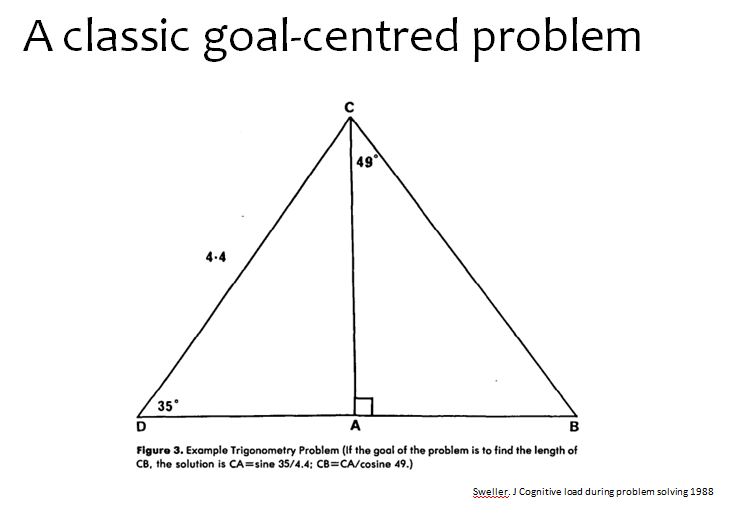
Sweller’s solution was to remove the goal and replace it with a simple instruction: “find as many values as possible”. The computer modelling showed no increase in the complexity of the task, indicating the lack of a goal did not make the task harder. It did show less iterations of the problem-solving algorithm, indicating the cognitive load was less demanding on the resources of the working memory.
By removing the goal, students are forced to engage with the initial conditions of the problem with greater depth and form multiple connections between ideas. As there is no right answer, every valid outcome has equal value so is encoded into the students’ schema. In a goal-centric approach, not only are the students overloaded by the idea of the goal. Also any other valid outcome which does not solve this particular problem, but might solve a different problem within the same context, is forgotten as irrelevant. I tihnk one of the most commonly ignored facts about the brain is the importance of forgetting.
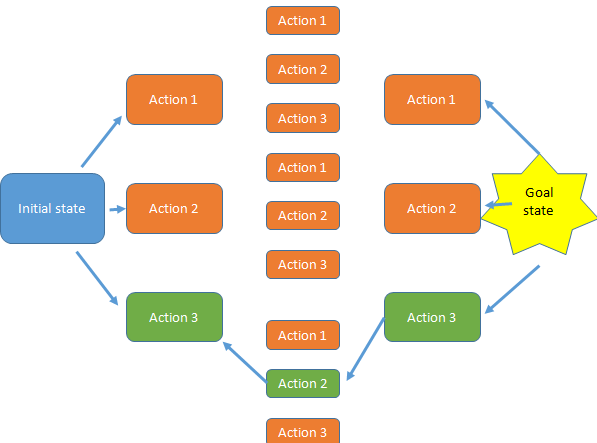
Fig 1. A means-ends approach to a goal-centred problem. Orange shows valid information that is forgotten due to not being relevant to this particular goal state. Green shows the solution to the problem posed.
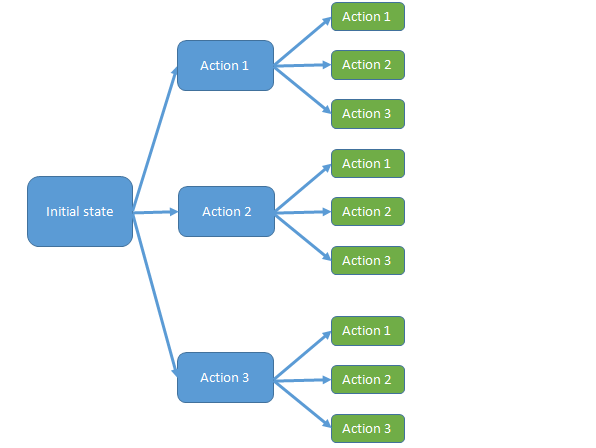
Fig 2. A goal-free approach values all valid information. Forgetting is not prioritised and so a richer schema is built
Does this mean we should let the students follow a discovery learning approach to ensure they build a rich schema?
No. The goal-free approach has some significant advantages, but it has some very particular conditions that need to be met for it to be successful.
- Novices shouldn’t attempt this. This is essentially the expertise reversal effect in action. Novices do not have enough understanding or experience to successfully navigate a goal-free problem. They need faded examples, explicit instruction and shed loads of practice (SLOP).
- The utility of the goal-free approach is limited. It works really well for maths, so any maths-based science would be an easy place to start. It doesn’t work well for all aspects of science, especially things that are essentially a narrow domain (e.g. fractional distillation); for those problems using the worked example effect is probably much better.
In my experience some of the best places for it in science are in all the data-handling questions. The questions about a graph or a data set are perfect for the goal-free approach. They encourage students to spend longer on the diagram/graph/table and they gain a richer understanding of the patterns and reasons. This significantly helped my students’ ability to answer those kinds of questions and I would recommend you try that first.
The presentation can be found here. Feel free to use it for any CPD if you find it helpful.

 Adam Robbins Education
Leave a reply to Appositives as retrieval practice – CogSciSci Cancel reply