
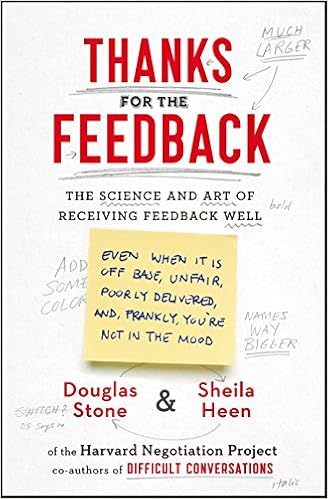
Douglas Stone and Sheila Heen have written an incredible book called “Thanks for the feedback”. It discusses the issues surrounding the receiving of feedback. I listened to it on audible, then bought a copy, I would recommend both versions. It’s been fascinating as a teacher, but also as a father and a husband, to look at how people react to feedback and how the same words can elicit different effects in different people. The world is awash with feedback and often we are not receptive to it. This blog distils some of their ideas and my own experience and tries to consider what can be done as observers of lessons to ensure the feedback is heard and acted on.
The learning walk cycle is predicated on the importance of feedback. It is recommended that feedback be given in a timely fashion, ideally face to face, focussing on both the strengths and areas of development. There are various structures that people are told to use: feedback sandwiches, ping pong and bungees are all commonly touted in training as tools to help you frame the feedback conversation effectively. Although if I’m being honest that’s not entirely true, one of those I just made up to illustrate how leadership training loves a good gimmick.
As the person delivering the feedback there is one irreconcilable problem you face. You have no control in how your feedback is received. A teacher can do many things to try and get students to pay attention, but they can’t physical force a student to think. Similarly, you can set your conversation up as well as humanly possible, but that doesn’t mean the teacher will hear your feedback.
Consider the following scenario *FADE TO BLACK*

(Scene opens in a typical school on a typical day. It’s lesson 3 and there is a smell of chips cooking in Food Tech down the corridor. The classroom door opens and in walks someone on a learning walk. They smile and, with a clipboard in hand, they sit at the back of the class. After a while they talk to the students, look at some books and then leave. After the last bell they pop into your room with their clipboard.)
Observer: “Can I give you some feedback?”
Me: “Sure.”
O: “I really liked the feel of the class. They seem to like you and you have built strong relationships. They work for you.”
M: “Thanks.”
O: “I think to improve you should get the students to just indicate with a show of hands which questions they got right so you can use it to inform future teaching.”
M: “Ok, thanks.”
O: “But once again, thanks for having me in and well done.”
END SCENE
Unfortunately for the observer this is what I heard:
O: “Can I judge you?”
M: “Sure.”
O: “Blah blah blah relationships blah blah blah work blah.”
M: “Thanks.”
O: “I don’t like the fact that you reject self-report because I like proxies that make me feel good.”
M: “Ok, thanks.”
O: “Once again, token thanks.”
Now, you might be reading this and thinking several things:
- What an honest and brave admission of a problem we all have but never admit, bravo!
- Wow! What an ungrateful idiot.
- I never do that.
- People listen to my feedback because I care and make sure it’s the best it can be.
- What’s wrong with self-report?
Whatever your thoughts one thing should be clear: the observer had no control in how I was going to take their feedback on that day. I don’t always take it this badly, but sometimes I do.
And so do you.
The word feedback can mean three different things. When someone asks for feedback they could be asking for:
- Appreciation: some words of encouragement
- Appraisal: to know how they are performing
- Coaching: to know how to improve
There is a caveat: coaching has an element of appraisal built into it. You can’t suggest improvements without identifying weaknesses.
If the two people involved in the feedback conversation have differing ideas about what they want to discuss then the conversation will be doomed before it even starts.
The first step to a successful feedback conversation is to be clear with the receiver what you intend to provide and what they are looking for. This doesn’t have to be as stilted as “Good day Sir/Madam! I am going to have a coaching conversation with you. Are you willing and able to receive this conversation?”
Start off by just talking. Ask how their lessons have gone and how their day has been, and you will quickly get the idea of where they are at mentally. This can allow you to tailor the feedback appropriately. If you and the receiver are far apart in your aims you will need to move them towards your aim or agree another time to feedback. There is no point wasting this feedback on a person unwilling to hear it. You will at best make no change to their teaching and at worst lower their morale.
Triggers
Now we have established the purpose of the feedback and we are aligned we have the next hurdle to overcome: triggers.
Triggers are barriers that can be in place that prevent the feedback being heard. The person might be receptive to feedback in general but certain things about this particular feedback might trigger a barrier to their listening.
There are three kinds of triggers that might stop a teacher listening to your feedback.
- Relationship triggers: The feedback might be spot on, but they don’t respect your opinion so won’t listen.
- Truth triggers: The feedback just seems false from their point of view.
- Identity triggers: The feedback makes them question something they hold as part of their core persona. If the feedback is right, it will make them question who they really are.
All three triggers are common in teaching. School politics, policies and personalities make them inevitable. These triggers are potentially there in any feedback conversation; they are an unavoidable aspect that leaders need to deal with. It is in an observer’s best interest to try and be wary of them when giving feedback, but the solution may not always be straight forward. For example, let’s consider a simple relationship trigger:
As a new leader you are observing a staff member who you do not see eye to eye with. You have disagreed on things in the past and have a bit of a personality clash. This is your first time observing them where you are their superior and, in the observation, you have noticed some things that could be significantly improved.
This is not a situation that can be solved instantly. Well, you can solve the relationship issue by not telling the truth, lavishing appreciation on them, and avoiding confrontation. Unfortunately, this will not help the teacher or students in the long run.
If we agree that is not the way forward, then we need to have a candid conversation and use a few simple tips to ensure some of the feedback is heard. Initially this will not improve the relationship. However, if the feedback is specific and effective then as the teacher notices improvements in the classroom, they will recognise your intentions and the relationship trigger will diminish.
As you can see, removing triggers is a complex issue with many context-dependent factors to consider.
However, there are some general suggestions which will help:
- Make sure your comments are detailed and considered, especially the positive. The detail shows you care and avoids the listener brushing it away as a token gesture.
- If it is an issue that might seem hard to be believed find some proof. Might they agree to video a couple of lessons so they can see for themselves? Or get a second observer to look at a different lesson. So many people have blind spots for certain aspects of their teaching.
- Give areas of improvement as suggestions and then get them to commit to giving it a try to see how it goes. Instead of “Use the visualizer to live-model the paragraph,” pose it as a question. “Have you considered using the visualizer to live model the paragraph?… Why not?…. Do you think we could put it down as a target to try and see how it goes?” This removes the identity trigger as you are not threatening their key values (which in this case might be about Powerpoint).
- In general, never underestimate the power of curiosity. Ask questions to direct the teacher towards the areas you think they need to explore. “You didn’t check for understanding enough before the practical” becomes “I’m curious, how many students do you think fully understood the instructions?… How could we improve that number?…One of the strategies that I’ve seen work well in other classes is….”
Feedback is a vital aspect of any learning walk system, but it is a tricky issue. Like most of education, it is complex and not entirely under your control. As a leader, it is your duty to find a way to get the message through without destroying morale. After all education is not a zero-sum game; we can all improve as teachers and as leaders. We are all in this together.


Leave a Reply