
On Friday’s CogSciSci conference in Surrey Dr Gareth Bates will be talking about ‘Most teachers are getting retrieval practice wrong, are you?’ It got me thinking about my own routines and what other practice I see when I visit schools. So I thought that before I saw his talk I would put my proverbial flag in the sand so that I can hold myself to account and maybe change if I learn something new.
Retrieval practice is an incredibly powerful and widely used strategy in education. While it is true that retrieval occurs whenever you ask students to recall information so should happen throughout the lesson I am focussing on retrieval quizzes that often start lessons. I’ve written about how most retrieval is poorly executed before here. However there seems to persist so many common misconceptions I wanted illustrated a few broad issues with a little thought experiment.
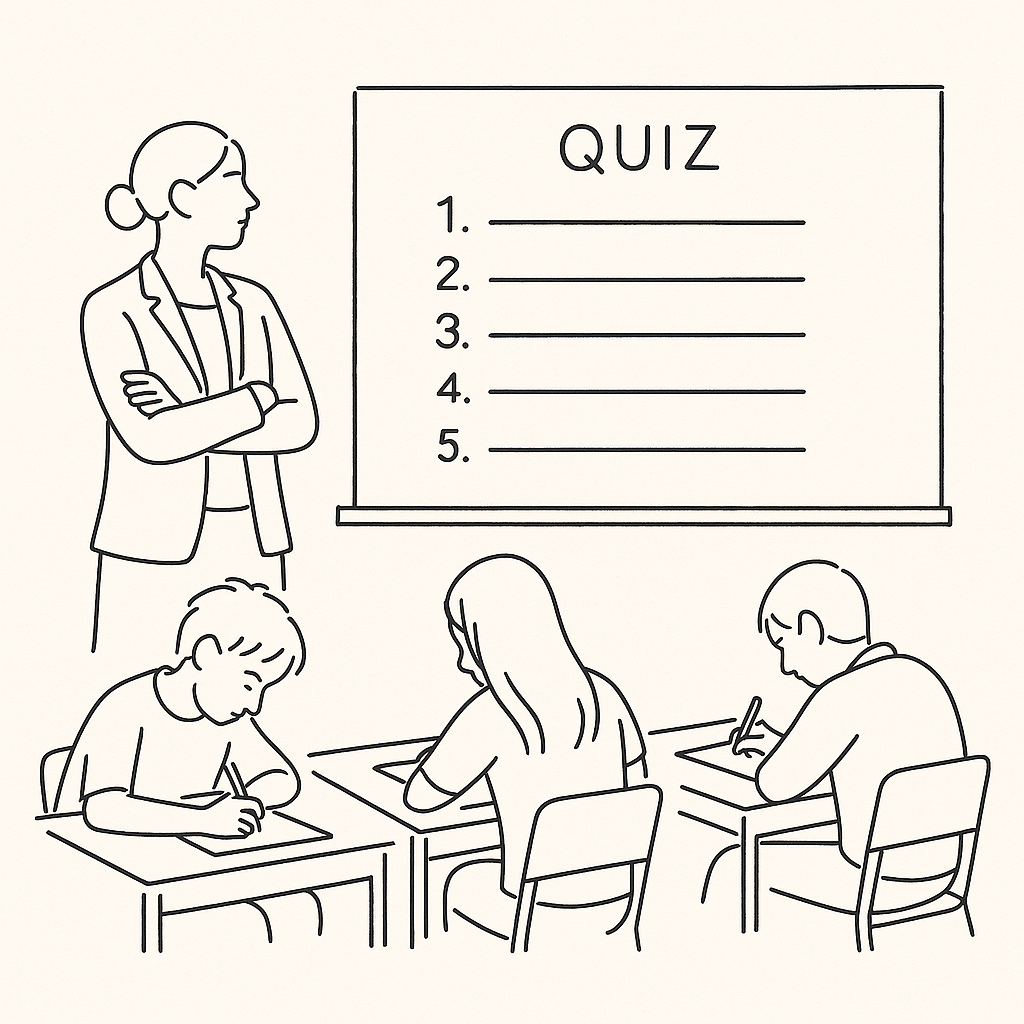
Four students, A, B, C and D, enter a classroom as part of a whole class. The teacher has displayed 5 questions chosen from all curriculum content covered so far. They all collect their books and sit in their places.
A reads the questions and writes the answers in full sentences in their book. They answer 4 questions before the time limit is reached.
B finds writing hard but diligently concentrates on writing the questions down in their nearest handwriting but the teacher stops the class before they have the chance to answer the questions.
C doesn’t write anything. They read the questions and think about the answers.
D reads the questions and just writes the simplest answers possible. They answer all the questions.
The question is: Who learns the most?
Well this is where it can get a little contentious. If we assume that ‘memory is the residue of thought’ and ‘whoever does the thinking, does the learning’ then some of these students clearly can make a stronger claim to have enhanced their learning than others. Obviously there are various caveats that people could provide to invalidate any claims I am about to make, but evidence suggests that reading for most is relatively automatic and retrieval is similarly thought to happen somewhat automatically. As this is just a thought experiment we will assume a simple model of if it is read it is thought about and if you think about a question your brain automatically tries to retrieve the information.
- A probably adds something to their learning. Let’s say they get a score of 4/5 because they have thought about 4 of the 5 questions.
- B probably doesn’t add anything to their learning. They are solely focused on writing neatly, as such the content of the sentence is probably broken down so much it loses its cohesion and the question is most likely not thought about. Let’s give them a score of 1 /5. Adam Boxer calls this busy tricking.
- C is interesting. They in theory have a score of 5/5 but because they have thought about each question and retrieved the answer. However we have no evidence of this. So while we might consider their score 5/5 from a cognitive perspective, from an educational perspective we are relying a lot on trust. Without the threat of inference it is easy for the students’ attention to wander and so their effective learning might be less than 6 in reality, but for this experiment let’s assume it doesn’t.
- D seems like an easy case for a 5/5. Because they write the answer they are accountable and can prove they have thought about each question. From a cognitive perspective it seems pretty clear cut. From a practical perspective there might be a small issue; dead time. They will finish much quicker than A and B so might be just sitting there twiddling their thumbs. I’ve seen teachers add more open ‘stretch’ questions at the end to occupy these students, or personally I just get them to read the upcoming section of the booklet to prep them for the lesson.
I think many schools encourage A and B. Often the reason is given that ‘so students can look back in their books if they are stuck’. For me I think this shows another misunderstanding of retrieval practice. Imagine you are trying to learn the lines from a play and every time you can look at the script, will you ever get off-book? I think if a student can easily go back a few pages and find the answer then it tells me two things:
- The student will still not know that answer, but think they do. This will make them happier but also less aware of the need to retain that information.
- The teacher is not effectively choosing questions from a broad enough area of the curriculum. (Yes there are caveats like being early in the course, but in general teachers are prone to having favourite questions they recycle more often.)
When it is all said and done I think the case is pretty strong that D is the best overall strategy. Yes it doesn’t look as nice in the book, and this can require leaders to be educated on what a good book looks like because it will make their QA senses twitch, but it has a good level of accountability that is focused around the cognitive process of retrieval practice and is also quick. That means you can get through it faster and on to the marking and feedback sooner.
Regarding the feedback I think there is less evidence to suggest what the best way of providing it is. Personally I like a bit of cold call rather than just showing the answers. From a cognitive perspective I doubt it is better, although there is an aspect of repetition. I like it mainly from an accountability and culture perspective. I tend to keep track of students’ answers while I circulate and if I see a right answer to a tricky question make a mental note of who to ask. This way we get to demonstrate to the students that got it wrong that it is possible to know this answer in this class. It helps a establish a norm of ‘others know this so you should’ It also offers me the chance to stretch a student with a follow up question if I think there is a valuable one.
What about feedback?
I was never a fan of students self reporting their success by raising their hands, but since carousel released ‘c-scores’ I have found it useful. Self report is always something you should take with a pinch of salt but the ability to track students success over time really helps me target their homework quizzes.


 Adam Robbins Education
Leave a reply to Sarah Comfort Cancel reply